3D Printing for Drones: Why FDM is Now a Full-Scale Manufacturing Strategy (Not Just Prototyping)
A few years ago, FDM 3D printing was the tool you pulled out to make a quick test part before the real manufacturing started. Now that story has flipped. For drone and UAV manufacturing, FDM has become one of the most practical and cost-effective paths to actual production — not just a stepping stone toward it.
The reason comes down to how the drone industry works: fast design cycles, short product lifespans, and a constant need to adapt. FDM fits that rhythm better than almost anything else. Here’s how.
1. You Can Start Production in a Week
Traditional manufacturing has a painful setup phase. Contractors, tooling, injection molds, assembly line calibration — you’re looking at months before the first part rolls out.
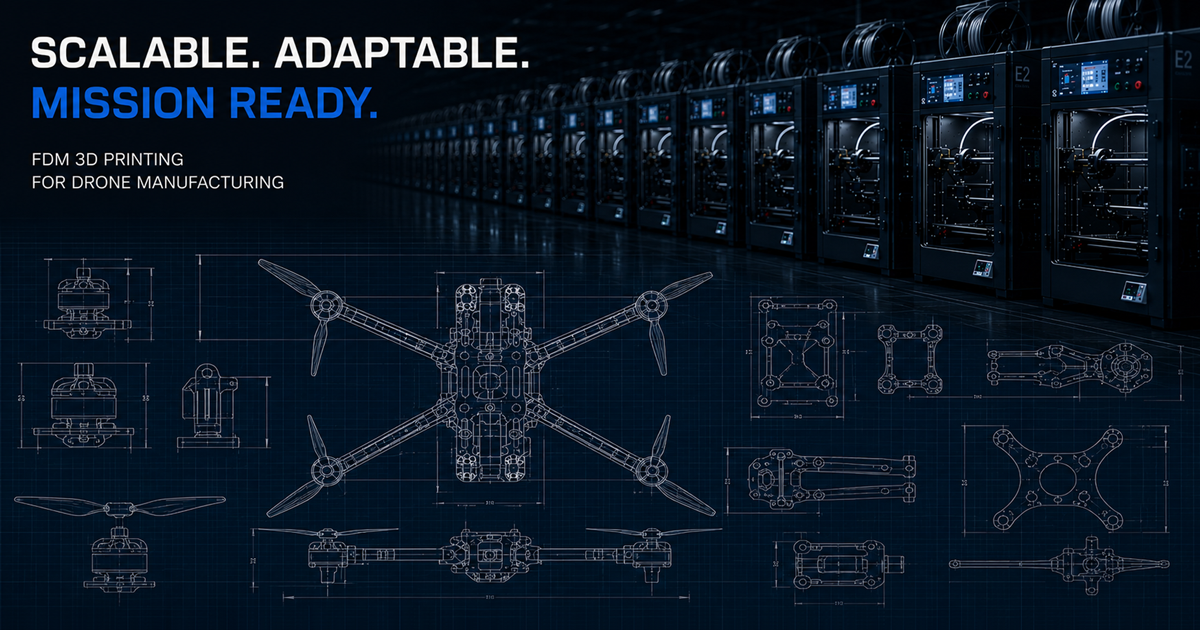
With FDM, you skip most of that. Set up a printer farm, connect your existing machines, or split the order across local hubs. Need to scale drone production fast? Add more printers. It’s not a metaphor — it actually works that way in practice.
For drone makers, time-to-field isn’t a nice-to-have. It’s the whole game.
2. From Rapid Prototyping to Mass Production — Same Day
Drone designs change constantly. A new camera mount, a different antenna bracket, a tweak to the cooling geometry. In traditional manufacturing, any change means new tooling, new wait times, new costs.
FDM closes the gap between rapid prototyping and mass production almost entirely. Once an R&D test passes, you print the updated version. No new molds, no factory downtime, no supply chain holdups.
The same logic applies to your production tooling. Jigs, templates, fixtures, worker aids — all of it can be printed and updated in hours. The whole line stays current without a retooling budget.
3. Distributed Manufacturing Removes the Single Point of Failure
One centralized factory is a liability, especially in defense and dual-use markets. It makes your supply chain fragile, your logistics complicated, and your entire production vulnerable to a single disruption.
Distributed manufacturing with FDM changes the equation. You can spread production across cities, countries, or partner facilities. You’re not shipping heavy equipment — you’re sending a digital file and print settings. Production moves to where the drones are needed, not the other way around.
For defense tech and UAV manufacturing, this isn’t just convenient — it’s a structural advantage.
4. The Economics Work When Product Lifecycles Are Short
In defense tech, a drone can be obsolete before a traditional production line pays for itself. Spending serious money on injection molds for a product that’s going to change in six months is a losing calculation.
FDM flips that math:
- No tooling or mold costs
- Low entry barrier — start small, scale when ready
- Design updates cost almost nothing
- Small and medium batches stay profitable
- Flexible scaling up or down without waste
The right filament for drone parts — whether PETG for impact resistance, Nylon for flexibility, or ABS CF / Carbon Fiber filament for structural UAV components — can be swapped to match each design requirement without changing the production setup.
FDM Is Now a Complete Production Strategy
3D printing for drones stopped being a workaround a while ago. It’s a full production strategy — scalable, adaptable, and built for an industry that can’t afford to wait. Whether you’re running a printer farm in-house or distributing production across multiple sites, FDM gives you the speed and flexibility that traditional manufacturing simply can’t match at this pace.
The question for most drone and UAV manufacturers isn’t whether to use FDM production — it’s how fast to scale it.